
What is Pathological Demand Avoidance (PDA)?

Some children do not simply ‘refuse’ everyday requests.
A simple instruction like “put your shoes on”, “brush your teeth”, “come to the table” or “it’s time to leave” can trigger a level of distress that seems much bigger than the task itself.
For parents and carers, this can be confusing and exhausting, especially when your child can manage the same task easily one day, then find it completely overwhelming the next.
For some neurodivergent children, this pattern may be described as a PDA profile, or Pathological Demand Avoidance.
PDA is best understood not as deliberate defiance, but as a nervous system response. The child may experience every demands as overwhelming, unsafe or as a loss of control. Their avoidance is often driven by anxiety, stress and a strong need to feel in control of what happens to them.
What is PDA?
PDA, or Pathological Demand Avoidance, is a profile discussed in relation to autistic and neurodivergent children. It is characterised by an extreme avoidance of everyday demands driven by high levels of anxiety and a nervous system response to perceived threat, rather than deliberate behaviour.
For example, a child may want to go to the park but still become distressed when asked to put their shoes on. They may enjoy school once they are there but still find getting ready or leaving the house incredibly difficult.
PDA is not a standalone diagnosis
PDA is not currently a separate diagnosis in the DSM-5. Some clinicians may describe a child as having an “autism profile with demand avoidance” or “autism with a PDA profile”.
The purpose of identifying PDA-style demand avoidance is not to label a child. It is to better understand what is happening underneath the behaviour, so the child and family can be supported in a way that actually helps.
PDA (Pathological Demand Avoidance) is a profile often seen in neurodivergent children, characterised by an extreme avoidance of everyday demands driven by high levels of anxiety and a nervous system response to perceived threat rather than deliberate behaviour.
Early Signs Families May Notice
🚫 Strong resistance or avoidance of everyday demands, even simple ones
🧠 A tendency to see themselves as having equal or adult-like status in interactions
🙂 Can appear socially engaged on the surface, but may have difficulties with deeper social understanding
🎯 Strategic avoidance behaviours (e.g., distraction, negotiation, humour) that seem to show awareness of what triggers demand
🌊 Big mood changes and intense emotional responses that can shift quickly
💭 Strong or obsessive focus on specific people or relationships
🎭 Comfortable in role play, imagination and pretend play, sometimes in a very immersive or intense way
❌ Frequent “no” responses as a way to manage feelings of pressure or demand
🔄 Fluctuating capacity: abilities and engagement can vary significantly from day to day or week to week . For example: a child may happily attend school and participate one week, and the following week may struggle to go or refuse entirely
Is it oppositional defiant disorder? What’s the difference?
PDA can sometimes look like oppositional behaviour from the outside, but the internal experience may be very different. 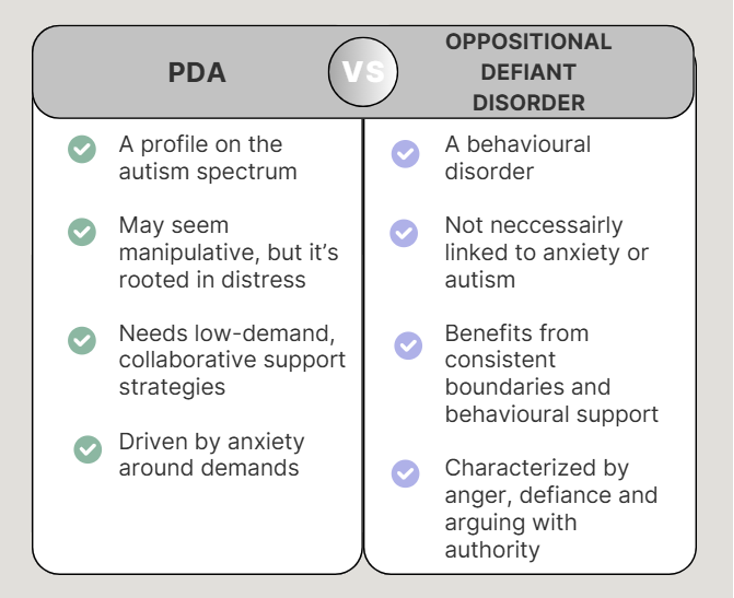
A child with demand avoidance may say no, argue, run away, shut down or become angry. However, the behaviour is often linked to anxiety, overwhelm or a need to regain a sense of safety and control.
With PDA-style demand avoidance, the child may avoid things they actually want to do. They may feel unable to comply, even when they understand the request and even when there is a reward or positive outcome attached.